
Accueil - PIANO MOVING QUESTIONS
Moving a piano often raises the same questions: how much does it cost, is it insured, and how do I find a specialist near me? Piano Moving Transport , with over 1,000 5-star reviews in Quebec, answers all these questions and assists its clients throughout the province.

All your questions about moving a piano — we have the answers
Let’s be honest: moving a piano isn’t like moving a sofa. It requires specific expertise, specialized equipment, and above all, people who know what they’re doing. Whether it’s an upright piano that’s been sitting in your living room for 20 years, a grand piano that needs to be moved out via the balcony, or a collector’s item that you absolutely can’t afford to lose, questions quickly arise. And that’s perfectly normal.
We see it every week at Piano Transport Moving. People call us, write to us, and often they have the same concerns.
Individuals moving house for the first time with their piano. Music schools needing to move several instruments. Piano tuners wanting to ensure the job is done right. Families who have inherited an old piano and aren’t quite sure what to do with it. All these people have legitimate questions, and we try to answer them as best we can.
Over time, we noticed that certain questions came up in almost every call:
That’s why we created this page. We’ve compiled over 80 questions—the ones we receive most often—with truly useful answers, not just fluff. Answers based on our actual experience, not on theories. The idea is that you can arrive at your move knowing what to expect, without any unpleasant surprises.

To save you from having to read everything from beginning to end, we’ve separated the questions by topic. Looking for something about pricing? There’s a section for that. Want to know how to protect your instrument during transport? That’s covered there too. Have a difficult access situation, a spiral staircase, or a piano that needs to be brought through a window? We’ve got you covered.
The topics covered include: our experience and reputation, prices and estimates, insurance, pre-move preparation, handling techniques, winter moves, service areas, difficult access, the team, high-value pianos, and post-move (acclimatization, tuning, maintenance).
We’ll be discussing practical questions: How can you tell if a company is truly reliable? What’s the average price in Quebec? How do you pack a piano to protect it? Does it always need to be tuned after a move? How many movers does it take for a grand piano? What happens if the staircase is too narrow? And if I have to move in February, is that really a problem?
In short, real questions with real answers.
Whether you are an individual, a school, a conservatory, a performance venue or a music store, this FAQ is here to inform you, not to sell you something.
Browse the sections below at your own pace. And if you don’t find what you’re looking for, contact us directly — we’d be happy to discuss your situation and see what we can do for you.
Didn't find the answer to your question?
Our team of experts is available to answer all your specific questions about moving your piano.
We’ve been doing this for over 13 years now. Thirteen years of moving pianos all over Quebec. Upright pianos, grand pianos, family heirlooms, collector’s items. We’ve worked with individuals moving for the first time, professional pianists who don’t entrust their instrument to just anyone, music schools, and even institutions like the Montreal Conservatory of Music and the Montreal Opera. Suffice it to say, we’ve seen it all.

What are we most proud of? Our customer reviews. Not because it’s good for business—although it helps—but because each review represents a real piano that we carefully transported, a real person who trusted our team. Today, we have over 1,000 reviews on Google, with a 5-star rating. That’s not something we take lightly.
We are also fully insured, and we travel anywhere in Quebec—without exception. Downtown Montreal, a small rural town, a more remote location: no matter where you are, we’ll come to you. The work remains the same: meticulous, safe, and of the highest quality.
For over 13 years, Piano Moving Transport has been helping individuals, music schools, conservatories, and professionals move their pianos safely. With over 1,000 5-star Google reviews, full insurance coverage, and service throughout Quebec, we do everything we can to ensure every move is stress-free and without any unpleasant surprises.
Piano Moving Transport has over 13 years of experience in piano transport. Since 2013, we have completed thousands of moves for individuals, music schools, conservatories, performance venues, and businesses throughout Quebec.
At the time of this page’s publication, we have already had the privilege of moving over 10,000 upright and grand pianos throughout Quebec. Behind this number are thousands of clients, music schools, conservatories, performance venues, and many other institutions who have entrusted us with their instruments.
What pleases us most is seeing this trust continue to grow year after year. To give you an idea, in 2020 we were moving an average of about three pianos a day. Today, in 2026, that average has risen to nearly five moves a day. For us, this proves that word-of-mouth, customer recommendations, and the quality of our work make all the difference.
Honestly, if you look at who’s calling us, it’s really a bit of everything.
The majority of our clients are individuals. Someone moving from Laval to Quebec City with a piano in their living room. A woman who just inherited her mother’s piano and isn’t quite sure what to do with it. A couple who bought a used piano on Marketplace and realize it doesn’t fit in their car. We know these situations inside and out. But we also have clients who come back year after year—music schools moving their instruments between locations, conservatories, universities, and performance venues undergoing renovations.
Over time, these organizations have learned that we do the job properly, and they call us back.
What people don’t know is that we don’t just make pianos. Hospitals often contact us to move heavy equipment, or construction companies need us to move something fragile into a difficult location. High-end furniture stores also call us, as do IT companies with delicate equipment to transport. Whenever something is heavy, bulky, or expensive to replace, people think of us.
Because we saw how it was done, and we realized it didn’t make any sense. The founder of Piano Transport Moving is first and foremost a musician—he studied at Cégep and the Conservatory—and an amateur weightlifter. Someone who knows as much about music as he does about the mechanics of the human body. And it’s precisely this combination that’s at the heart of it all.
One day in Montreal, he watched two movers carrying a piano on their backs with straps. 600 pounds. Down a street, sweating it out. He didn’t judge them—it can happen from time to time, in certain situations. But the question that crossed his mind was: how can you do that 3, 4, 5 times a day, week in and week out, without wrecking your back? The obvious answer is that you can’t. Not for long, anyway.
That’s where the idea took root. By applying the laws of physics—the same kind of reasoning a weightlifter uses to lift heavy loads without injury—he developed a handling technique unique to Piano Moving Transport. A way of working that protects both the movers and the instruments.
The result? You’ll never see our guys carrying a piano on their backs. And if you read our Google reviews, you’ll notice that this is one of the things that comes up most often: our movers’ unique technique, their attention to detail, their unconventional way of working. It’s not by chance. It’s been at the heart of what we’ve done from the very beginning.
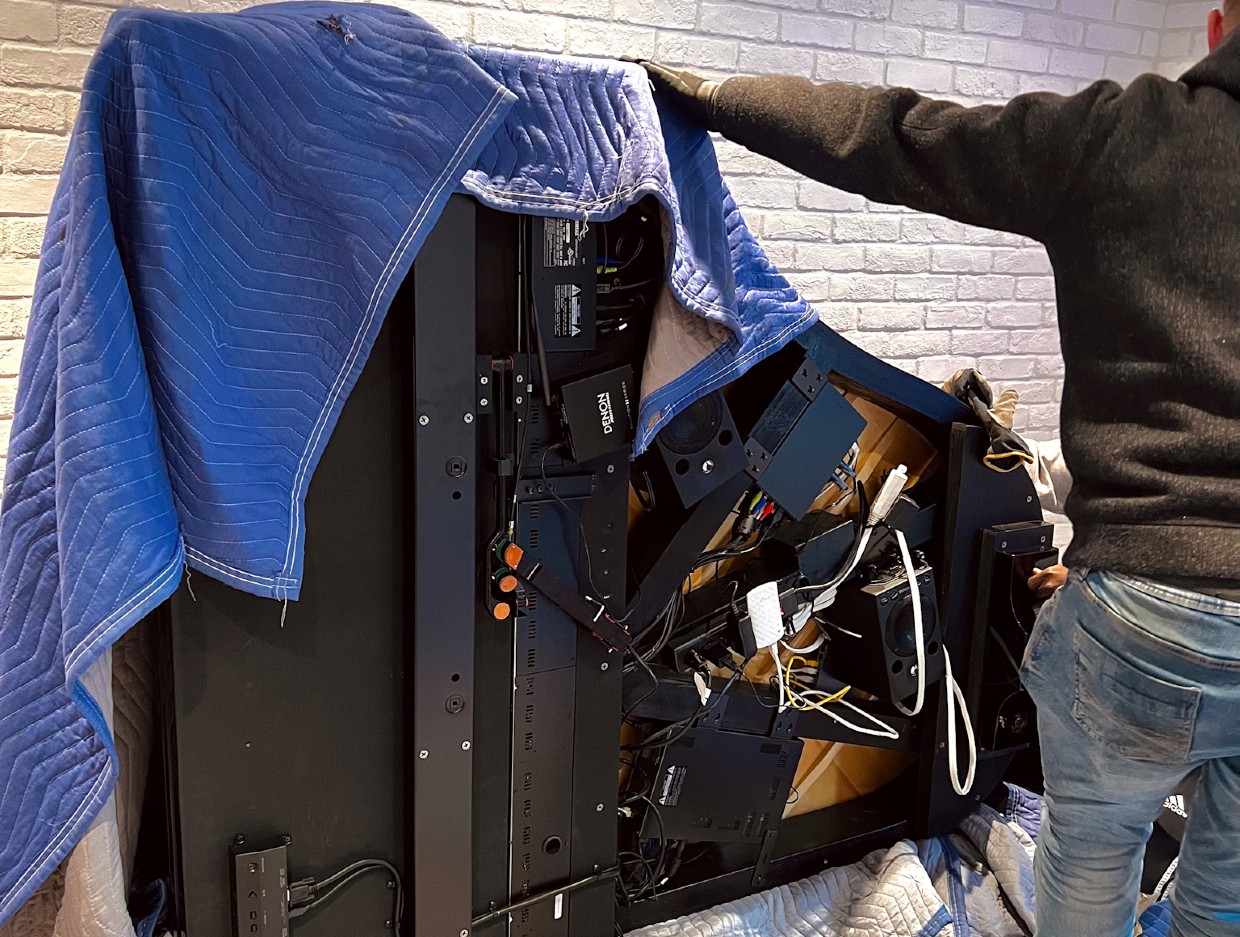
Is your company insured for moving pianos? That’s the question we get asked most often, and frankly, we understand why.
The problem is that the web and platforms like Marketplace are full of so-called “piano moving specialists.” These are people who set out with a truck and two straps, without training, without proper equipment, and above all, without valid insurance. The stories circulating don’t always have happy endings: pianos dropped down stairs, instruments scratched or structurally damaged, and no one to take responsibility for the damages. The customer is left to deal with the consequences alone.
It is precisely to avoid this kind of situation that we advise you to ask two simple questions before entrusting your piano to anyone.
First: Is the company registered with the Quebec Enterprise Register? It’s a quick, free check, and it already tells you a lot. Second: Can they provide proof of insurance? Not just tell you they’re insured—show you a document.
Because not all insurance policies are the same. Some only cover a portion of the damages. Others require the customer to pay a deductible if an incident occurs. And in some cases, insurance simply doesn’t cover piano transport, even if the company presents itself as a specialist.

At Piano Moving Transport, we do things differently. We’re one of the few companies in Quebec that handles every aspect of the move from start to finish—from the moment we enter your home until the piano is installed at its destination. And if anything happens during our service, you won’t have to pay any deductible. Zero. It’s our responsibility, and we take full responsibility.
When shopping for a piano moving service, don’t just rely on price. Check who you’re actually hiring.
Yes, and not just the piano. When our team comes to your home, the entire job is covered—the piano, of course, but also your building. If we hit a wall, if a staircase is damaged, if the floor is scratched during the maneuver: that’s our responsibility, period.
Piano Moving Transport is insured by La Coopérateurs. Our coverage includes two components: cargo insurance (protects your piano during transport) and liability insurance (covers damage to your property or that of a third party). This is not a verbal promise—it’s a formal policy with a recognized insurer.
Incidents are extremely rare, but we are transparent: minor damage → agreement reached on site; major damage → piano sent to a specialist workshop, full repairs covered, you are informed at every step. In all cases, you pay nothing.
No. We cover 100% of damages with no deductible for the customer—which is rare in this industry. And to be honest: it happens very rarely, as our Google reviews show.
At its current market value. Additional tip: obtaining a written appraisal from a tuner before moving simplifies matters in case of a claim.
Yes, throughout Quebec, through La Coopérateurs. Proof of insurance is available upon request — and all customers are encouraged to request it, regardless of the company chosen.
Approximately 40 lbs of heavy-duty blankets, covering 90% of the surface, with a layer of plastic as needed. Never half-hearted packaging—every instrument is prepared with meticulous care.
Rubber-wheeled trolleys, piano tray, thick blankets, protective tape, disassembly tools. Nothing improvised.
Enhanced content on the real risks of a bad move (out of tune, damaged structure, unplayable instrument).
Value> $70,000 → additional insurance (declared/daily value), between 3.5% and 5% of the piano’s value. This must be mentioned when requesting a quote.
Every move is a different story. The house isn’t always the same layout, and neither is the piano. Sometimes access is complicated, with stairs or narrow hallways. Other times, it’s simpler. You can’t really lump everyone together. That’s why we take the time to assess each situation, to offer a price that reflects the reality of the work involved.
Several factors come into play. The type and weight of the piano, for example, make a big difference. Going up or down stairs, especially narrow or spiral ones, adds to the workload. The distance between the old and new homes, of course, directly impacts the cost. And then there’s access: a straight path is one thing; if you have to maneuver around tight turns, it complicates things. Sometimes, you even have to call in a crane if the piano needs to be brought through a window. Finally, the number of movers needed is also a consideration, because the more complicated the move, the more help you’ll need.
Yes, without a doubt. Grand pianos are often larger, heavier, and more delicate to handle. It takes more time, more care, and sometimes more movers to ensure everything goes smoothly. It’s considerably more complex than moving an upright piano.
Yes, with us, insurance is always included in the price. No hidden fees or surprises. Your piano is protected throughout the entire transport, and we make sure everything is properly covered.
Yes, we offer a fixed, all-inclusive price. No hidden fees to surprise you at the end. We believe in transparency; you know from the start what it will cost you, including travel expenses. No secrets there.
Because it takes more time and often more people to do the job safely. The risk of damage is also higher when access is narrow or complex. We have to be careful, which means more effort, and therefore, the price goes up a bit accordingly.
Yes, it can reduce costs. Since we’re already on-site for your move, the travel expenses are shared. Plus, we can coordinate services to make everything more efficient. It’s a win-win situation.
We always work with fixed prices. This prevents you from stressing out by seeing the bill increase while we’re working. A clear price before we start is the best way to do things.
Yes, provided the information is accurate. This is where it gets serious: clear photos, descriptions of access points, the number of steps—all of this helps us make a precise assessment. If we discover any surprises on moving day, it can affect the price. So, to avoid that, we really insist on having an accurate picture of the situation from the outset.
Not at all. The price remains the same all year round. In winter, it might require more caution regarding the weather, but we don’t charge more for that.
Yes, absolutely. The greater the distance, the more fuel, time on the road, and logistics are required to plan the transport. It can also require more stops or a different approach depending on the route. We take all of this into account so that the price reflects the reality of the trip.
This can stem from several factors, such as insurance, the team’s experience, the quality of the equipment used, or even the level of care given to the piano. We’re not criticizing anyone, but it’s important to understand that a very low price can sometimes involve compromises. Our priority is safety and quality.
Yes, absolutely. We offer free estimates, with personalized advice to help you plan your move. It’s always best to be prepared before you start.
The photos help us better understand the layout of the space and the piano. It’s much easier to assess potential challenges when we can see the access points, the stairs, and the size of the piano. This helps us avoid unpleasant surprises and gives you a more accurate price.
Yes, in those cases, we take extra precautions. An antique or valuable piano requires even more delicate handling, sometimes with additional protective measures. This is certainly reflected in the price.
A deposit is only required for long-distance moves. This secures your booking and allows for worry-free planning. For local moves, no deposit is required.
We accept credit cards, debit cards, Interac Money, and checks. We want to make it easy for you, whatever your preference.

Yes, and we do it all winter long. But you can’t just jump into it haphazardly. We use a piano platform, very thick blankets, and we’re really careful about temperature changes when we take the instrument in and out of the buildings. It’s not complicated, but it requires experience and care.
Yes, it can happen. The wood, the strings, the mechanics… all of that reacts badly to extreme cold. That’s why, below -15 degrees Celsius, we prefer not to take any risks and postpone the move. It’s better to wait a few days than to end up with a damaged piano.
Yes, we do it regularly. At Piano Moving & Transport, snow doesn’t stop us. We’ve developed our methods over the years, and so far, we’ve never had an incident due to snow. With the right precautions, everything goes very smoothly.
Honestly, it happens. Winter in Quebec is unpredictable. People often book months in advance, and you can’t know in January what the weather will be like in March. What we do is keep a close eye on The Weather Network in the days leading up to a storm. If a storm is coming, we’ll call you so we can find a solution together—either we move it up or we postpone. We always try to arrange things so that it causes as little disruption as possible.
We stop working when it gets down to -15 degrees Celsius. That’s our limit. At those temperatures, it’s dangerous for the piano, but it’s also very difficult for our staff to work outside. No one can perform properly in that kind of cold, and we don’t want to put our employees or your instrument at risk.
Yes, absolutely. Heavy rain, freezing rain, snowstorms, or ice storms—all of these complicate the work and increase the risk of accidents or damage. We always assess the situation before setting out, and if the conditions are truly bad, we prefer to postpone rather than push through.
We start by wrapping the piano in about five thick blankets to protect it from the cold. Then, over the blankets, we apply a tightly wrapped plastic film—called shrink wrap—to block out moisture, snow, and rain. It’s a method we’ve perfected over time, and it works really well.
Yes, and it’s important. Whether it’s winter or summer, it’s always recommended to leave the piano alone for at least two weeks after moving it. If you call the tuner too soon, the wood hasn’t had time to settle in its new environment, and the tuning won’t hold. It’s a shame to pay for nothing.
Yes, and it’s important. Whether it’s winter or summer, it’s always recommended to leave the piano alone for at least two weeks after moving it. If you call the tuner too soon, the wood hasn’t had time to settle in its new environment, and the tuning won’t hold. It’s a shame to pay for nothing.
Yes, it usually takes longer. There are several reasons for that. First, finding a parking spot for the truck near the door is often a real headache when snowbanks block the entire street. Second, if the driveway isn’t plowed, you can’t get the truck as close as you’d like. And icy steps slow everyone down—you can’t exactly be running around with a piano in your arms. In short, in winter, you take your time.
Yes, and it’s really important. We ask that you ensure the entrance, sidewalk, and steps are clear of snow and ice before we arrive. Use salt or sand if it’s slippery. We’re piano movers—not snow removal specialists. If the access is dangerous, it jeopardizes the safety of our team and your instrument. A clean access is essential for everything to go smoothly.
Would you like to know if our team travels to your location? Below you will find answers to frequently asked questions regarding our service areas, our routes throughout Quebec, and our long-distance piano transport services.
Piano Transport Moving operates absolutely everywhere in the province. Whether you are in a major urban center or in a rural area, we are there for you.
Yes, without exception. Our logistics coverage encompasses the entire territory of Quebec.
Absolutely. Greater Montreal and its surrounding areas (North Shore and South Shore) are part of our daily operations.
Yes, we handle intercity transport, whether it’s a short distance between two neighboring municipalities or a journey of several hundred kilometers. We coordinate every step to ensure your instrument travels in the safest possible conditions, regardless of the route.
Yes, the Montreal-Quebec City route is one of our most frequent routes. We regularly operate trips in both directions to meet our clients’ needs.
Yes, we serve these cities several times a month. Whether it’s an upright or a grand piano, our teams are equipped to handle even the most complex access situations (narrow staircases, multiple floors, etc.), regardless of your location.
Absolutely. With us, moving a heavy and fragile instrument over a long distance is done with complete peace of mind, and always at a fair and transparent price.
Yes, we go everywhere. However, for more remote areas, our trips are generally scheduled once a month or every two months. That’s why we ask for some flexibility from our clients so we can consolidate shipments and optimize costs.
Yes, we regularly provide secure transport of upright and grand pianos between Quebec and Ontario.
Yes, our expertise doesn’t stop at Quebec’s borders. We can transport your instrument to Ontario, New Brunswick, and Nova Scotia.
For major urban centers and surrounding areas, we are available every week. For more remote regions of Quebec, our trucks travel there every 4 to 8 weeks.
Yes, rates are adjusted based on distance. In some more remote areas, demand is lower, which doesn’t always allow us to combine several contracts on the same day. Travel expenses therefore help cover our teams’ fuel and travel time, but we always do our best to offer you the most cost-effective solution.
Yes, absolutely. Thanks to our network of trusted international partners, we can orchestrate the complete transport of your piano between Quebec and Europe (including France and Belgium), or vice versa, in a custom-made protective case.
Our best advice? Don’t wait until the last minute to book! The earlier you book, the better, especially if your move falls during the high season (between May and July) or if your instrument requires special logistics.
To orchestrate the transport of a piano professionally, schedules fill up quickly. Depending on the time of year, it can easily require several weeks, or even a month or two in advance, to guarantee you a suitable time slot and assemble the ideal team.
When looking for a company to move a piano, the first question that comes to mind is: “Who’s going to carry it? Do they really know what they’re doing?”
And it’s normal to be a little stressed. The profile and skills of our guys are literally in the top 5 questions our clients ask us first.
To save you headaches and reassure you before the big day, we have compiled below the questions we receive most often with our direct answers.
Because a piano isn’t moved like a piece of furniture. Its weight is unevenly distributed, its finish is fragile, and the risks are high on stairs or in narrow passages. A specialized team knows the proper techniques and has the necessary equipment to transport the piano without taking unnecessary risks.
We’ve been transporting pianos since 2014. Since then, we’ve moved thousands of them all over Quebec. Each member of our team has experience with over 1,000 pianos, which makes a big difference when the project becomes more complex.
Yes. Every new mover receives theoretical training, then participates in the transport of over 100 pianos alongside our most experienced employees. After this period, they are able to assess a situation, choose the right method, and work independently while adhering to our standards.
In approximately 80% of cases, we send three movers. For simpler moves, two may suffice. Conversely, some very difficult access situations require a team of four to seven people. The number is always determined based on the piano and the conditions on site, never arbitrarily.
We transport upright pianos, grand pianos, organs, as well as antique, Victorian, and collector pianos. Regardless of the model, we always adapt the transport method to its weight, dimensions, and available access.
When we talk about a collector’s or high-value piano, we’re not just talking about a piece of furniture with sentimental value. We’re referring to rare, often very expensive instruments that require meticulous care.
Specifically, this category includes:
Absolutely. And honestly, our proudest achievement is our work for the Montreal Conservatory of Music. We moved several Steinway pianos there, as well as other prestigious instruments. Not just talk: take a look at the video below to see our teams in action!
Absolutely. We regularly work on period pieces, antique models with rare cabinetry, or pianos of great historical value. These instruments require extreme care, and that’s exactly the kind of technical challenge our guys excel at.
Yes, our standard insurance policy covers piano transport up to $75,000. For an instrument exceeding this value, no worries: we can arrange temporary, one-day insurance specifically for the event. The premium typically ranges from 3.5% to 5% of your piano’s current market value.
Yes, constantly! Whether it’s a 9-foot concert grand piano or a hard-to-find limited edition, we’re used to handling these giants of music.
Absolutely. For this type of project, we generally send two or three extra movers as backup. The protection is also doubled: while a standard piano gets a good layer of padded blankets, a collector’s piano receives double reinforced protection with a complete wrap in industrial plastic film even before loading.
Yes, the price is indeed higher than for a regular piano. This is simply due to the cost of special insurance, the additional equipment used, and the number of people needed to ensure a smooth and trouble-free transport.

One of the questions that comes up constantly when people call us is whether tuning is included in our moving price, or if our guys can tune the piano directly on site after it has been installed.
To avoid any unpleasant surprises and to help you properly plan the maintenance of your instrument, we have compiled below the questions we are most often asked on this subject, along with our expert advice.
Yes, it is highly recommended to have your piano tuned after moving, even if it was transported with the utmost care. Vibrations and changes in temperature and humidity can affect the tuning of the instrument. However, it is recommended to wait 1 to 2 weeks after moving to tune the piano. This will allow it to stabilize and adapt to its new climatic environment.
Honestly, no, it’s really a bad idea to have your piano tuned right after moving.
Even if the instrument looks immaculate upon arrival, remember that it has just undergone a whole series of thermal and climatic shocks during the journey: the vibrations on the road, the change of air between your old home, the truck, and then the new house…
If you call a tuner right away, you’ll be throwing your money away. The wood and strings will continue to shift for a few days, and the piano will go out of tune almost immediately.
The trick is to wait a good 2 to 4 weeks. This gives the soundboard and wood time to stabilize and acclimate to the humidity of your new room. Only after this period will the tuning really hold.

Piano purchase 2024

Questions transport piano 2024

Piano technician 2024

